Women Business Angels’ seven lessons training course on How to Take Off as a Business Angel? brought to life in the framework of the WINGATE project has the goal to develop and train women entrepreneurs and women business angels across all Europe.
The first event of the training series took place on the 1st of March and had as an expert guest Péter Csillag.
Péter Csillag, President of HunBAN, former co-founder and CEO of Starschema is a technology business building and scaling veteran. For some years, he worked as a data technology expert at large multinational enterprises, then founded Starschema, the most successful Hungarian data technology service provider serving Fortune500 clients globally. Peter has a good overview of how founders need to grow a global tech business and has the attitude to help and mentor them to reach their potential.
Women Business Angels: What do you see as missing in the startup/angel investor scene in Central and Eastern Europe compared to the North-East, e.g. Estonia? Péter Csillag: Many things. One important thing we miss here is self-confidence, believing we can achieve similar results as our role models. Without this belief, the ambition levels will never be similar to the more developed startup ecosystems, and we will never reach our full potential. Other is the one (or more) step distance from politics. Politics is poison for startups and the economy.
WBA: How was the EBAN meeting? What are the key ideas you see as essential to passing on to the local community and industry?
PCS: EBAN meeting was fine, not many surprises – and that was good. EBAN leaders shared the info they were expected to share, Angel organisations of Europe shared their success stories and problems, startups pitched their businesses, and everything was just as expected. Somewhat boring for the “startup guy me”, but this kind of stability and predictability are required to provide constant support and services to the startup ecosystem.
No significant, groundbreaking key ideas to pass on – just consistent communication and respect for common goals from all participants I have met there. All startups, accelerators, supporting organisations, and governmental or private entities emphasized the same goals and set the same major priorities – no “fights” or “parties” were visible.
WBA: What would you do differently if you could start building Starschema again? / What advice would you give to people just starting their startup career?
PCS: Gaining knowledge the hard way sounds fun, but it’s not (or not always). We had no good advisors or mentors in our early days, which made our journey much longer. We have made many unnecessary mistakes, burnt too much energy on wrong goals, and executed improperly. In our later years, we have built management from experienced and talented people, engaged advisors who “were there done that” – and I realised that the knowledge was always out there, I just was not aware of it. Help from the right people could have spared us many years to get where we are today.
So my advice – if you want to build a killer startup and scale it fast – find the right people, mentors, advisors, and co-founders then pick their brains. If you think you miss an important skill or knowledge – find it in somebody else. If you think you have all the skills – think it over again.
WBA: Are you a mentor or more of an angel investor?
PCS: Both. I like starting a relationship with a startup by providing mentorship and turning it into an investment later. Investment is not a must – finding and helping new teams and startups is.
WBA: What would be your advice for startups when teaming up with an angel investor? Are there any red flags/green flags you could share with us?
PCS: As a startup, you don’t have to accept money from an angel automatically; you can (and should) be selective. Choose an angel (or any other) investor based on two significant criteria:
What is the investor’s motivation? Money only? Acceptable, but not optimal. Enthusiasm for the idea/product only? Red flag for me. Trust in the team? Much better. Combination of all these? The best.
Does the investor have experience with the specific market and the investment in similar phase companies? 2 YESs mean green light, one YES is yellow, and two NOs are like red flags.
WBA: How do you see the role of women in angel investing? PCS: Women angel investing is still rare in Hungary, as I can see – and I’m not happy with it. Women were never (and to a large extent still aren’t) conditioned to be active decision-making participants in the economy. Before the last few years, they never had the chance to decide on investing in startups. It also means that startups founded by women were mainly invested by men so far. It should change – we need much more women angels!
Women Business Angels’ seven lessons training course on How to Take Off as a Business Angel? brought to life in the framework of the WINGATE project has the goal to develop and train women entrepreneurs and women business angels across all Europe.
The third event of the training series took place on the 7th of June and had as an expert guest Gábor Patkó.
Gábor Patko is a senior executive with a 20-year track record of success building, growing, transforming and managing online and offline businesses across 3 continents. In his work, Gábor tends to combine a strategy consultant’s rigorous and systematic approach with an entrepreneur’s energy and get-things-done attitude all the while focusing on the continuous development of those who he works with. After gathering significant industry experience in various fields, in 2021 Gabor decided to launch his own startup, SkillCert.io.
SkillCert empowers its users to compete on equal terms with their professional peers by providing an affordable, recognized, and reliable way for them to prove their individual skills to employers in the international job market.
We asked Gábor about his motivation to become an entrepreneur, mentoring, and the Brazilian innovation ecosystem compared to the European (CEE). Last but not least we were also curious about his thoughts on why are women much needed in the investor community. Enjoy the conversation.
Women Business Angels: How would you introduce yourself to our readers?
Gábor Patkó: I’m a globally-minded idealist who still believes he can change the world for the better 🙂
WBA: What made you become an entrepreneur in your forties? Do you regret it?
GP: I’ve always been an entrepreneur at heart but I either lacked the courage or the right idea to go all-in. I was fortunate enough to find an idea I was passionate about at a point in my life where I feel I’m both well prepared for the ride and can take a risk
WBA: What company are you building now?
GP: I’m building SkillCert, a high-quality, low-cost skill assessment and certification platform which aims to democratize access to the global job market by credentialing candidates independently of their background/pedigree, merely focusing on their hard and soft skills
WBA: What role do mentors play in your career? Who are the most important ones and how do you maintain relationship?
GP: I found the right mentors for me late in my career but still feel thankful for having them in my life, whether it’s to give me difficult feedback I’m in need of, share insightful angles on challenges and opportunities i’m facing, or boost my confidence when times are rough
WBA: Who do you mentor?
GP: I mentor whoever asks me to be their mentor and who puts the effort in to drive the relationship. In my experience, mentoring is always driven by the mentee.
WBA: What is the status of Brazil’s innovation ecosystem compared to Europe/CEE?
GP: It’s hard to compare the two as Brazil is a much bigger market, attracts more capital, and has way less state intervention than Hungary. The cultural orientation to the US also significantly contributes to the ecosystem being on a much more advanced level of development, although it was practically a VC desert 10-15 years ago…
WBA: Why are women much needed in the investor community? Why do you think Women/Business/Angels Association plays an important role?
GP: Without going into specific clichés, women tend to have a different perspective and approach to most things in life versus men and are desperately needed to balance a strongly male-dominated industry.
Women Business Angels’ seven lessons training course on How to Take Off as a Business Angel? brought to life in the framework of the WINGATE project has the goal to develop and train women entrepreneurs and women business angels across all of Europe.
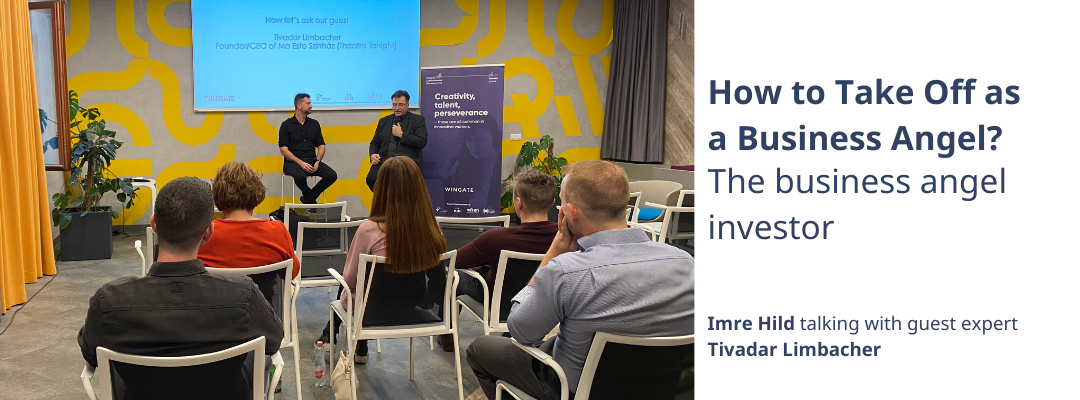
The third event of the training series took place on the 3rd of May and had as an expert guest Tivadar Limbacher.
Tivadar Limbacher, Founder/CEO of Ma este Színház Kft. (Theatre Tonight) told us very honestly about success and failure stories in the fields of start-up funding.
He explained how to resolve differences between the startup and the angel and gave excellent examples to learn from. Finally, he shared with us some details of the Budapest startup ecosystem and the collaboration of angels and his unique perspective on it.
We asked Tivadar about his experience and thoughts regarding the angel. Enjoy our short interview.
Women Business Angels: What was the main reason when searching for an angel investor instead of applying for a bank loan?
Tivadar Limbacher: We were active in the startup scene in Budapest during the first few years. During that time I participated and presented at several conferences, competitions and events. We were not looking for funding yet, our plan was organic growth and bootstrapping. Applying for an “official” loan with all the red tape definitely never crossed our minds. At one of these events, the angel and his funding found us, and we decided that it will speed up our growth.
WBA: What were the expectations, and what was the reality when you started working with the angel investors? How would you summarize the evolution of your businesses’ and angel investors’ relationship?
TL: We had no idealistic expectations that the “big money” or funding will solve all our problems. A little more guidance or more connections would have been nice to get at the time. Of course, now we know that a successful angel investor’s time is more valuable than his/her money. We accepted soon enough that we were still on our own.
WBA: What are the most important values an angel investor can bring to a startup in the CEE region? (Based on your experience)
TL: That’s the beauty of it. Being an angel investor is much more flexible and can be tailored than being a VC or private equity or let alone a bank. Based on my experience the ideal angel investor in the CE region gives much more than funding. S/he is a board member, a mentor and a motivator even, but definitely a team member in some sense, not only the funding.
WBA: What would be your advice for startups when teaming up whit an angel investor? Are there any red flags/green flags you could share with us?
TL: There are a lot of red flags alright. The most important is when they’re offering only “mentoring”, “connections” and/or “goodwill”. Such help might be legit, but the value they’ll bring is far less than the overhead. It is risky to offer equity in such cases. I would advise discussing the exact expectations from both sides. Discussing the details helps transparency and mutual understanding.
WBA: Which role do you prefer: being a mentor or an angel investor?
TL: So far I’ve only tried the mentor role – mainly because of the above. When I take equity, I want to be certain that I’ll bring value to the table. It is also important for me that I can expedite the team’s success significantly. Being a mentor is less of a commitment from both sides.
For me, it’s a personal development: first mentor, then an angel investor.
Women Business Angels’ seven lessons training course on How to Take Off as a Business Angel? brought to life in the framework of the WINGATE project has the goal to develop and train women entrepreneurs and women business angels across all Europe.
The second event of the training series took place on the 31th of March, and had as an expert guest Matt Wohlmuth.
Matt Wohlmuth is the CEO of Coding Sans. Coding Sans is a full-stack web development agency building complex, market-ready products from design to delivery. Coding Sans emerged from a venture-funded startup in Budapest, so they experienced the ups and downs of building tech products. The core team has been working together since 2013.
Despite being a young company, they have decades of combined design and coding experience building successful products.
We asked Matt about his experience as a startupper, but we were also curious about his thoughts on angel investment. Enjoy our short interview with Matt.
Women Business Angels: If you’d have the opportunity to start your career again as a startupper, what would be the key focus points you’d follow when building your company? Please share with us some practical insights startuppers in CEE should follow.
Matt Wohlmuth: Focus on your market, not applying for grants, no EU tenders, no competitions, just customers/users. No exceptions in the beginning either, it gets engraved in the cultural DNA of the company.
WBA: Are there specific challenges for those who would start a startup company in the CEE region? What is your experience?
MW: Finding Marketing and sales talent/experience is still difficult. We have world-class tech talent, but soft talent is really hard to find. Although the situation is much better than 10 years ago, a good marketer or salesperson is still a black swan.
WBA: You are also known as an angel investor. Would you share the key lessons you have gained from your investments with us?
MW: How interpersonal conflict between co-founders can be a big headwind for teams, and how effectively managing those conflicts can really make a difference. Market and customer-focused entrepreneurs win.
WBA: When starting an angel investment, are you working with a team? Who are the key people, and what are the key areas you focus on to help a startup grow? Are there specific challenges for those who would start an angel investment in the CEE region?
MW: I’ve never done an angel round alone. Working together with other angels has been the key to our (initial) success.
Balazs Komár – CEO of xLabs, co-founder of ISEEQ – exceptional in talent acquisition and arguably has a better network than me.
Steve Ruszina – CEO of Invention Factory – they did org dev at the early Hungarian exits Ustream, Balabit. He is the best coach that I’ve seen.
Szabolcs Erki, CEO of Hard Code, the agency of smart things.
Gergely Hodicska – Felhő – ex-VP of Engineering at Ustream and Bitrise. He is a technically minded organisation builder and good to have on the team.
In the CEE region, fewer company operators are willing to invest in startups, and the ones willing have significantly less capital than our western counterparts.
WBA: What are the most important values an angel investor can bring to a startup in the CEE region? (Based on your experience) Can you share with us a success story?
MW: Expertise and network. What was surprising even for me was when I was able to help a portfolio company find a dev in Kazakhstan – that was pretty random 😀
Summary on The role of women in re-launching the economy and innovation decision making
Forum & policy stakeholder roundtable
Live in Budapest & online on 22 November 2021
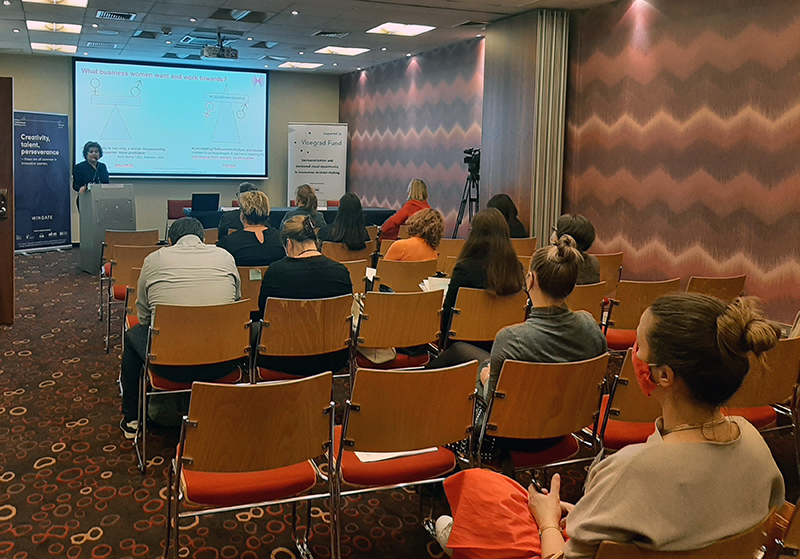
On 22 November 2021, Women/Business/Angels organised a hybrid event on the role of women in the economy and innovation decision making. The forum was organised in Budapest live, as well as streamed via Zoom to participants across Europe, from Norway to Georgia.
Eszter Szabó, president of WBA opened the event, welcoming both online and offline participants, and introducing WBA’s mission to support women in entrepreneurship and innovation investments. She warned about the hardships startups face when – regardless the innovativeness of their ideas – financing is almost impossible to find at their early stage of developments. That is where business angel investors have to step in and with funds, network and mentoring they can add to the success of those innovations. Women currently underperform in these fields, though utilizing their potential can seriously increase economic developments of the region.
Marianna Neupauerová, deputy director of the International Visegrad Fund gave her opening speech, starting with a quote from Eleanor Roosevelt, saying “a woman is like a tea bag. You never know how strong it is until it’s in hot water.” She emphasized the IVF’s approach to support female entrepreneurs and business actors. As the Visegrad countries are now losing their advantages in international competition with low labour costs, they must be more innovative to avoid the middle-income trap. Furthermore, she highlighted that it is not only important from the point of economics but also regarding sustainability: women empowered with the knowledge and skills to run and finance their own enterprises are more resilient in times of social and economic turmoil, like the pandemic.
The topic of the first panel discussion was the steps and measures we shall take in order to increase the share of women in innovative enterprises – as founders and funders.
Eszter Szabó, president of WBA pointed out the need for more role models and building long-lasting cooperations within the countries and across.
Beatrix Bedő, who is an angel, trainer, lead incubator and co-founder of Impact Hub at Budapest, pointed out the need to include a more diverse set of actors, that is not only the business angel community we shall work with but other financial actors as well. Beatrix also stressed the need to move beyond the capital regions and invite women from smaller cities and rural areas to cooperate, innovate and invest.
Irén Márta, director of the Business Development Council for Sustainable Development in Hungary agreed on the need to acknowledge female leaders and excellent achievers, and not only in the first executive line but also those who are in second, third positions in organisations but have the motivations and skills to step ahead.
The second panel of discussion focused on best practices from several countries. First, Rita Anson from WIN Network, Norway shared her insights regarding working and investing with women into female-led businesses. In her experience, women have the funds but not the incentive and courage to invest on their own, so we have to embolden, train and support them in doing so. In WIN Network’s program women started to invest even during their training once they were presented with a good opportunity and felt safe and inspired. It is crucial to have role models that pave the way and a community that helps to build self-confidence.
Emilia Mamajova, co-founder of Espira Investments from the Czech Republic, told us that in their practice, all female entrepreneurs – regardless of whether they end up also being funded or not – receive ample care, feedback on their business plans, team and networking support in order to promote more women in the field. Emilia also pointed out the need to invest together – as smaller female investors may not dare to go out on their own, but are happy to learn from investing together in a group. Investment syndicates are a great starting point for beginners to learn.
Aleksandar Bijelic from SeVen, Serbia told us a special case about an innovative service, invented by women that opened up a whole new ecosystem segment – for other women as well. But at the start, they needed advice, mentoring in team building and promotion, network support and a lot of encouragement in order to dare to launch their idea. Now they act as local role models for others to look up to. There is also significant governmental support in Serbia for female entrepreneurs and a will to increase women in STEM education and jobs.
In the next step, Theresa Hitchings, ABB Eastern Europe Executive and WBA’s Advisory Board member, summarised the key findings of the forum and stressed the need for women supporting women especially in areas, industries and segments of the economy still considered to be “a man’s world”. Having built a career in the aviation industry, Theresa had first-hand experiences in this journey.
Closing words for the event came from Janina Lamøy, Innovation Norway. Janina called for a better inclusion of women into innovation decision making, citing a case where a successful innovation was able to emerge only because female investors understood the customers’ problem and the ingenuity of the offered solution. But Janina further re-phrased the forum’s discussions not as simply supporting women in the world of men but as the need to build diverse ecosystems, diverse workplaces and diverse enterprises. We need diversity not only in gender but in various terms in order to be able to address the diverse challenges our societies face. We need to build inclusive societies, a society for all.
As the forum ended, Eszter Szabó, president of WBA thanked all speakers for their ideas and insights, and all participants, online and offline – for their interest and time and for the donors for supporting our efforts to encourage women in their innovative enterprises. The forum was organised with the financial assistance of the International Visegrad Fund and the EEA and Norway Grants Fund for Regional Cooperation. The event presented two parallel running projects in the domain of female entrepreneurship and business angeldom.
Watch the Zoom recording of the event below, or click here:
Women/Business/Angels is a beneficiary partners in the WINGATE project, funded by Iceland, Liechtenstein and Norway through the EEA and Norway Grants Fund for Regional Cooperation. This consortium works across Norway, Serbia, Hungary, Romania and Moldova, supporting and training women entrepreneurs and women business angels.
Women/Business/Angels Association is the consortium leader of a project, co-funded by the International Visegrad Fund, with participating partners from the Czech Republic, Poland, Slovakia, Georgia and Moldova besides Hungary. We aim to support the development of business angeldom and innovation ecosystem building in these countries and within that, the role that women play in making investment decisions in innovative startups.
Implemented by:
Business/Women/Angels Association aims to grow the number of angel investors in Central and Eastern Europe (CEE) and works with its coalition partners. The Association invites a wider audience, both women and men, to gain experience, learn about new opportunities and new ways to make the region’s economy stronger while having a return on investment for each. The Association was recognised as a European Best Practice by Candace Johnson, President of EBAN in 2017. The Association is non-profit, non-partisan. Members pay a yearly membership fee.
Stakeholders from Nine Countries Joined the First Regional Forum on The role of women in re-launching the economy and innovation decision making
Budapest 22 November 2021 – V4 countries together with Georgia, Serbia, Romania, Norway and Moldova joined the regional forum in Budapest on 22 November 2021, supported by the International Visegrad Fund and the EEA and Norway Grants Fund for Regional Cooperation.
At the hybrid event titled „The role of women in re-launching the economy and innovation decision making” speakers included Marianna Neupauerová (Deputy Director, International Visegrad Fund), Irén Márta (Director, Business Council for Sustainable Development in Hungary), Aleksandar Bijelić (Director, SeVeN, Serbia) and Janina Lamøy (Innovation Norway). The organizing Women/Business/Angels Association (WBA) aims to connect CEE stakeholders and to share best practices from business, academia and government.
„It is Women/Business/Angels/ Association’s strong belief that by connecting business angel investment and funding with innovative companies, countries can accelerate innovation capacity building as a competitive advantage in CEE” – pointed out Eszter Szabó, founding President.
„Working with CEE and Norway shows that there is a lot in common in the two places while building a stronger innovation ecosystem. We can learn from each other’s experiences and connections” – said Rita Anson from Winnetwork, Norway.
The Forum is a milestone in the efforts of Women/Business/Angels Association to invite more women into innovation and investments. Built on this stakeholder meeting WBA will present for chambers of commerce and major companies the need and opportunity to cooperate. WBA also starts a 5-session angel investing and mentoring training for CEE in the first half of 2022.
Women/Business/Angels is a beneficiary partners in the WINGATE project, funded by Iceland, Liechtenstein and Norway through the EEA and Norway Grants Fund for Regional Cooperation. This consortium works across Norway, Serbia, Hungary, Romania and Moldova, supporting and training women entrepreneurs and women business angels.
Women/Business/Angels Association is the consortium leader of a project, co-funded by the International Visegrad Fund, with participating partners from the Czech Republic, Poland, Slovakia, Georgia and Moldova besides Hungary. We aim to support the development of business angeldom and innovation ecosystem building in these countries and within that, the role that women play in making investment decisions in innovative startups.
Implemented by:
Business/Women/Angels Association aims to grow the number of angel investors in Central and Eastern Europe (CEE) and works with its coalition partners. The Association invites a wider audience, both women and men, to gain experience, learn about new opportunities and new ways to make the region’s economy stronger while having a return on investment for each. The Association was recognised as a European Best Practice by Candace Johnson, President of EBAN in 2017. The Association is non-profit, non-partisan. Members pay a yearly membership fee.
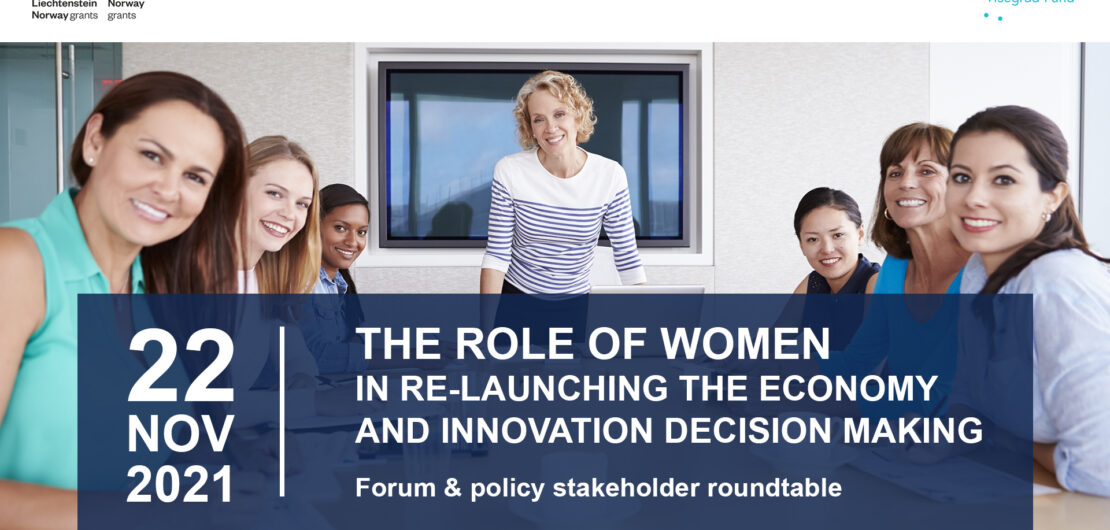
The role of women in re-launching the economy and innovation decision making
Forum & policy stakeholder roundtable
22 November 2021
Join us live in Budapest, or follow the discussion online!
The global pandemic has affected our lives in almost every aspect from our health and families to our economy and our prospects. It is a challenge not only to re-launch the economy but to re-launch it on a path that leads to more resilience, growth and sustainability on a national and a regional basis.
This path should include more women and more investments into innovation in the V4+ and the Central-Eastern European regions where market economy is much younger than in Western Europe. As a non-profit, nonpartisan organisation driving the discussion we connect stakeholders from two axes – V4+ countries plus Norway, Serbia, Romania – for the first time. This is why a policy discussion is long due on the topic of business angel investments, innovative start-ups and more female participation in both parts.
We invite the stakeholders to discuss their approach, share their opinions and display their results in special roundtables on innovation and business angel investments.
Program*
15.00 – 15.15 Registration, Welcome coffee Introduction of the “Ask about WINGATE!” desk
15.15 -15.20 Welcome from Women / Business / Angels Association – Eszter Szabó (President)
15.30 – 16.20 How to involve more women into innovation funding? Opportunities and bottlenecks
Policy stakeholder roundtable. (Supported by the IVF) Moderator:Edit Szilágyiné Bátorfi (Former Executive Director, IVF) Participants:
István Szabó PhD. (National Research, Development and Innovation Office, Vice President for Science and International Affairs)
Irén Márta (Director, Business Council for Sustainable Development in Hungary)
16.20 – 17.10 Innovation in many colors – Innovation support case studies with the support of the WINGATE project
(Co-funded by the EEA and Norway Grant Regional Cooperation Grant) Moderator: Beatrix Bedő (Co-founder, Incubation Lead, Angel, Impact Hub) Participants:
The event is an opportunity to learn from the experiences of two different projects that nevertheless have similar goals – supporting innovative women entrepreneurs and business angels – and an overlapping geographical coverage.
We are also beneficiary partners in the WINGATE project, funded by Iceland, Liechtenstein and Norway through the EEA and Norway Grants Fund for Regional Cooperation. This consortium work across Norway, Serbia, Hungary, Romania and Moldova, supporting and training women entrepreneurs and women business angels.
Women/Business/Angels Association is the consortium leader of a project, co-funded by the International Visegrad Fund, with participating partners from the Czech Republic, Poland, Slovakia, Georgia and Moldova besides Hungary. We aim to support the development of business angeldom and innovation ecosystem building in these countries and within that, the role that women play in making investment decisions in innovative startups.
In the framework of the WINGATE project, supported by the EEA and Norway Grants Fund for Regional Cooperation, Women/Business/Angels Association has organized a forum on the evening on 29 June 2021 around the theme of “Me as an investor”.
The goal was to show the aspects and details of business angeldom, to introduce newcomers – both entrepreneurs and potential investors – to the domain and to elaborate a bit on the tricks and treats of being an angel.
While Barbara Verő, WBA Club Director opened the forum live from the TRIP ship in Budapest, speakers also joined us via Zoom from all parts of Europe.
First, Eszter Szabó, President of WBA spoke about WBA’s mission and goals, then Renata Anna Jaksa introduced the WINGATE project – an international collaboration aimed at supporting, training and connecting women entrepreneurs and business angels. Trine Skymoen, Ambassador of Norway reminded us about the place of women – which is “at the helm, in the office, in the lab, in space and so forth” and urged business and society to “play football without benching half of the team – the women”.
Then Amparo de San José Riestra, CEO of the prominent Spanish IESE’s Business Angel Network and Board Member of EBAN urged angels and angel networks across Europe to share knowledge and collaborate with each other. Closing the first part of the programme, Ivar Siimar from the Estonian Business Angels Network emphasized the importance of syndicated angel investments – which allows to “combine your knowledge and expertise with other investors” and to learn by doing while risking only a limited amount of funds.
The next panel discussion, moderated by Imre Hild, WBA Training Director, offered a complex view of the dilemmas of angel investing. Participants were Júlia Sohajda (Vespucci Partners), Bea Bedő (Impact Hub), Zoltán Kovács. The qualified investors pointed out the role of angels – “be part of the team but not the boss”, and the need for openness and curiosity – “it is not the who-knows-best, but the how-can-we-learn”.
If you have any further questions, please do not hesitate to contact:
In the framework of the WINGATE project, supported by the EEA and Norway Grants Fund for Regional Cooperation, Women/Business/Angels Association has organized a forum on the evening on 29 June 2021 around the theme of “Me as an investor”.
The goal was to show the aspects and details of business angeldom, to introduce newcomers – both entrepreneurs and potential investors – to the domain and to elaborate a bit on the tricks and treats of being an angel.
While Barbara Verő, WBA Club Director opened the forum live from the TRIP ship in Budapest, speakers also joined us via Zoom from all parts of Europe.
First, Eszter Szabó, President of WBA spoke about WBA’s mission and goals, then Renata Anna Jaksa introduced the WINGATE project, this international collaboration aimed at supporting, training and connecting women entrepreneurs and business angels. Trine Skymoen, Ambassador of Norway reminded us about the place of women – which is “at the helm, in the office, in the lab, in space and so forth” and urged business and society to “play football without benching half of the team – the women”. She urged women to dare to take the lead, dare to step out of the shadow and make their own initiatives.
Then Amparo de San José Riestra, CEO of the prominent Spanish IESE’s Business Angel Network and Board Member of EBAN urged angels and angel networks across Europe to share knowledge and collaborate with each other. Closing the first part of the programme, Ivar Siimar from the Estonian Business Angels Network emphasized the importance of syndicated angel investments – which allows to “combine your knowledge and expertise with other investors” and to learn by doing while risking only a limited amount of funds.
The next panel discussion, moderated by Imre Hild, WBA Training Director, offered a complex view of the dilemmas of angel investing. Participants were: Júlia Sohajda (Vespucci Partners), Bea Bedő (Impact Hub), Zoltán Kovács. The qualified investors pointed out the role of angels – “be part of the team but not the boss”, and the need for openness and curiosity – “it is not the who-knows-best, but the how-can-we-learn”.
The forum was concluded with a lovely networking opportunity on board above the Danube.
WBA’s 2021 Autumn Semester is coming soon! We are preparing with info sessions and meet-ups for you about start-up eco-system and mentoring. Stay tuned on our Facebook and LinkedIn channel.
Women/Business/Angels Association held its 4th training in its 2021 Spring Semester series on 25 May, from 6PM CET. The training was a comprehensive walk-through on start-up and company evaluation, presenting the topic from every possible angle.
After Imre Hild, resident trainer of WBA opened the event and Eszter Szabó, president of WBA welcomed the participants, two special speakers were on board for the evening.
First, Emilia Mamajova shared her experiences. She is Founding Partner of ESPIRA Investments, a private equity firm targeting growth capital investments in Central-Europe-based SMEs with a special attention to gender balance. She talked about all the relevant financial and managerial factors to overview before making investments. Emilia highlighted that sustainability is the key in financial, marketing and management terms as well. The most important human factors are the integrity of the management and the trust relation between management and investors: to avoid micromanagement and too close monitoring.
Péter Kádas, the well-known Hungarian entrepreneur, investor and blogger talked about the case of early-stage startups, where traditional metrics are less relevant. According to Peter, “it does not matter how much of the company you’ll own -don’t be greedy!” – but to choose the right startups and to act swiftly are crucial. Make your decision and due diligence in 30 days – and be ready to move on! After all, only 10% of the exists make the 85% of the profits and not even all companies make the exit. Furthermore, keep some of your budget aside for follow-on investments – also called “doubling down”.
The training was closed by a short Q&A session and an invitation to our next event – the 4th Club on 8 June from 6PM CET.
How can you learn more about the Semester and join it? Fill in the registration form on the website!
If you have any further questions, please do not hesitate to contact:

 Women Business Angels’ seven lessons training course on How to Take Off as a Business Angel? brought to life in the framework of the WINGATE project has the goal to develop and train women entrepreneurs and women business angels across all Europe.






 The global pandemic has affected our lives in almost every aspect from our health and families to our economy and our prospects. It is a challenge not only to re-launch the economy but to re-launch it on a path that leads to more resilience, growth and sustainability on a national and a regional basis.

